No Results Found
The page you requested could not be found. Try refining your search, or use the navigation above to locate the post.
To Queer or Not To Queer: A Study Of LGBTQ Representation In Literature
This piece was a struggle from the start. I wrote it for my freshman year core english class. In all honesty, it was a learning experience. While I was used to writing my own ideas and content, I wasn’t used to being graded on work with such loose requirements. I floundered around for a topic, but eventually landed on queer literature. My initial topic was why queer literature is so prominent in YA spaces and how that effects perceptions of the genre. I started gathering sources, assuming the data I pulled from them would prove my point. A week or two before the paper was due, I discovered that my data actually disproved my thesis. So, with a looming deadline and all of my work scrapped, I started an immensely stressful week. Somehow, I pulled everything together into an essay I’m quite proud of. What you read here is the final draft of “To Queer or Not To Queer,” edited with feedback from my professor.

The queer literary genre has grown in size and popularity over the past few years. Queer literature, defined as subsections of other genres (i.e., queer fantasy, queer fiction, queer thriller, etc.) in which queer identity is prevalent and contributes to the story, influences the lives and identities of many queer individuals. Literary representation affirms and strengthens queer identity while providing a basis for a shared culture.
Originally published as a chapter in Thomas Peele’s book Queer Popular Culture: Literature, Media, Film, And Television, “‘Reading for It’ Lesbian Readers Constructing Culture and Identity Through Textual Experience,” an essay by Sheila Liming, discusses this phenomenon. In the lesbian community, “literature has long served as a vessel by which lesbian woman might come to terms with their identity.” I remember the books we queer kids would quietly pass around in middle school and what they did for us as a community. Liming, now an associate professor of writing at Champlain College, cites Rita Mae Brown’s Rubyfruit Jungle, Radclyffe Hall’s The Well of Loneliness, and Isabel Miller’s Patience and Sarah as the books of her lesbian community and identity. I cite Becky Albertalli’s Simon vs. the Homo Sapien’s Agenda, Rainbow Rowell’s Carry On, and Alice Oseman’s Heartstopper, which at the time was only available digitally.
While Liming read adult fiction, now more queer youth turn to queer Young Adult (YA) literature instead. For instance, all the books I listed here are classified as YA, meaning they were written and published with teenagers and early twenty-somethings in mind. However, there is no such thing as perfect representation. While queer YA does feature queer characters, it often lacks representation of intersectional minorities, or people belonging to more than one marginalized identity. Both because intersectional minorities are seen as unprofitable, and because the publishing industry employs very few minorities.
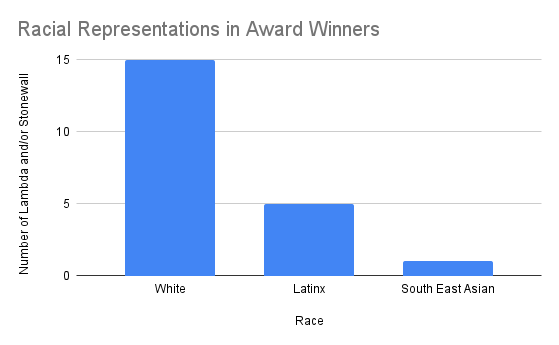
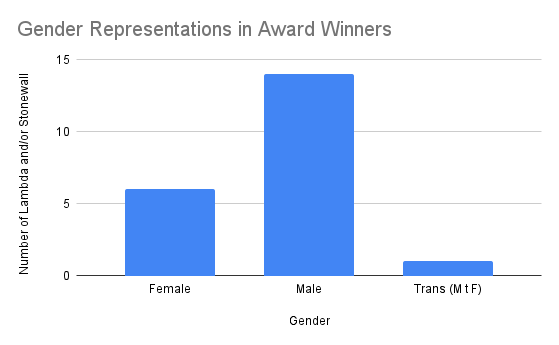
A study by Laura M. Jiménez, a senior lecturer and Associate Dean of Equity, Diversity, and Inclusion at Boston University, found disparities in diversity within celebrated queer YA as recently as 2013. Entitled “Representations in Award-Winning LGBTQ Young Adult Literature from 2000–2013,” the study analyzes recipients of Lambda and Stonewall awards, intended to celebrate queer literature, from 2000-2013. In this time frame, one-third of Lambda Award recipients featured a female protagonist, while only one of the fourteen protagonists identified as transgender. As for the Stonewall Awards, all represented protagonists were cisgender men. Even representation of varied sexual orientations like bisexuality, pansexuality, and asexuality went unrecognized. Combining the Stonewall and Lambda award recipients, Jiménez came to a list of 21 protagonists. Thirteen were cisgender gay men, five were cisgender lesbians, one was a straight transgender woman, and two more characters identified as cisgender and heterosexual (cishet). Of all the 21 protagonists studied, only six were people of color (POC). That means only 28% of recognized books featured POC representation. While this is worse than queer YA today, it is still exemplary of the culture within the genre and the literary industry.
I’ll Get There. It Better Be Worth the Trip, by John Donovan, is identified as the first instance of queer YA. Professor Christine A. Jenkins and recognized YA Expert Michael Cart assert this in their book Reading the Rainbow in Young
Adult Literature: LGBTQ+ Content Since 1969. Donovan’s novel, published in 1969, did not launch a literary revolution. Just nine books featuring queer characters hit the market over the next decade, according to Jenkins and Cart. The pair explains that the novels featured an exceptional amount of pain and suffering inflicted on their queer characters and a depicted impermanence of their queer identities. For queer people looking to literature for hope, positivity, and validation, early queer YA would not provide that.
“YA books are geared toward up-and-coming generations [and] what is changing in YA reflects what is changing in our world,” according to Michael Waters for Medium in “A Brief History of Queer Young Adult Literature.” If we take that statement as the truth, the lack of positive and diverse representation in early queer YA makes sense.
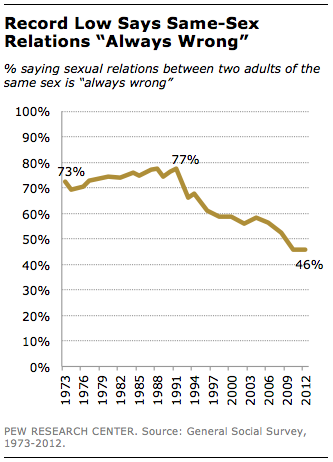
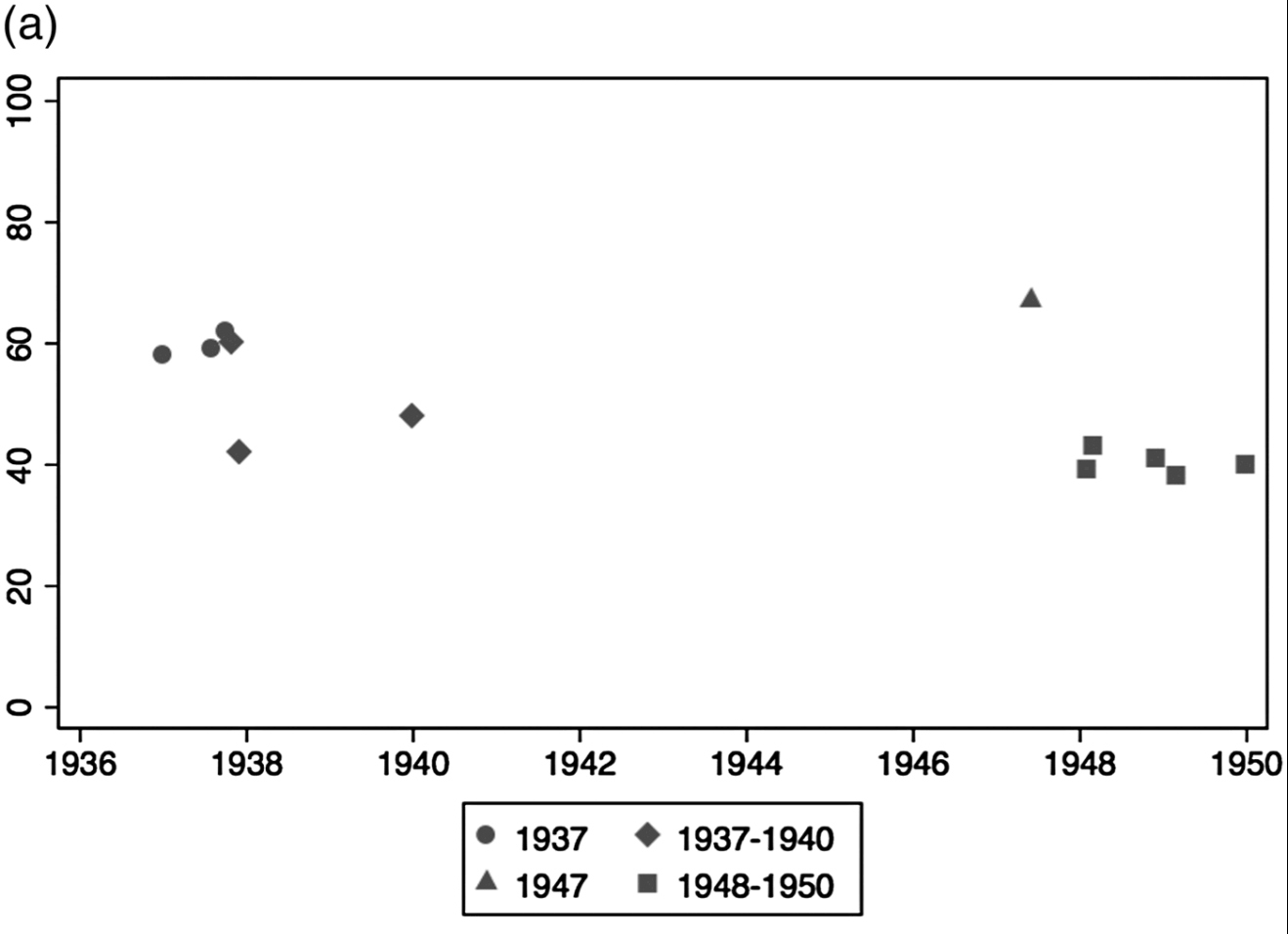
Decades ago, public opinion supported neither happy queer people nor POC queer people. In fact, data from 1973 shows 73% of people polled in one survey believe that homosexuality is always wrong, according to Seth Mothel in “On Stonewall anniversary, a reminder of how much public opinion has changed” for the Pew Research Center (figure 3). While I could not find data representing public opinion on transgender individuals from this time, according to Keegan O’Brien in the article “What LGBTQ Life, Activism, and Organizing in the United States Were Like Before Stonewall” for Teen Vogue, “gender transgression” was illegal through the 1960s. Looking at statistics for public support of African American individuals in the 1960s would not be particularly comparable to public opinion on queer individuals, as the queer rights movement began in the late 1960s (roughly 1969), while the African American Civil Rights Movement began in the mid-1950s. Looking at data from 1947, a more comparable time frame for the Civil Rights Movement, roughly 60% of people supported laws against lynching African Americans. Public support was not incredibly high for either of these groups, much less their intersections, so they were not the focus of published literature, including YA.
Good news, my Patreon has photos documenting my process on this piece–including text messages documenting my mindset during this process.

More posts of this type!